
Transformative social change and the role of the judge in post-apartheid South Africa

Transformative social change and the role of the judge in post-apartheid South Africa
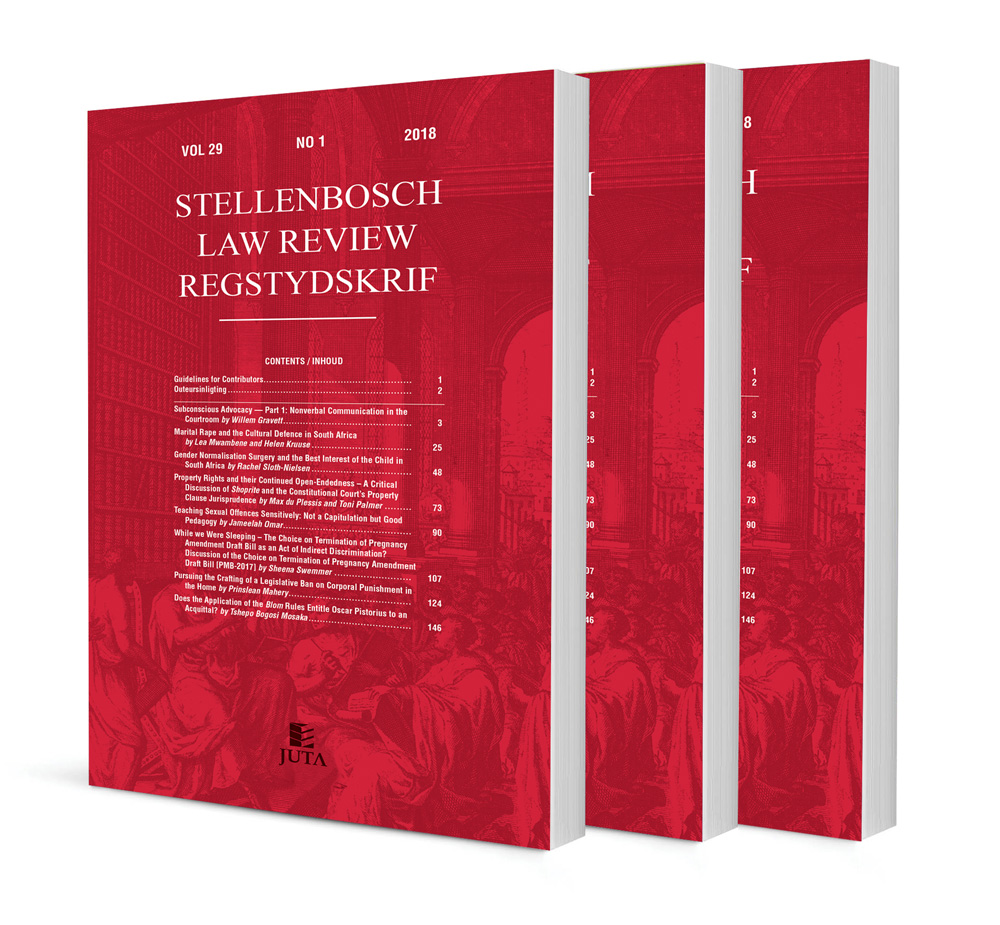
Author: Judge President Dunstan Mlambo

ISSN: 1996-2193
Affiliations: Judge President of the Gauteng Division of the High Court
Source: Stellenbosch Law Review, Volume 33 Issue 4, 2022, p. 595-604
https://doi.org/10.47348/SLR/2022/i4a1

Abstract

The Constitution of the Republic of South Africa, 1996 committed South Africa to a path of social transformation through its endorsement of the concept of transformative constitutionalism. Ultimately, this requires the transition of South African society from a state of deep inequality and injustice towards a more equal society characterised by social justice. Transformative constitutionalism has important consequences for the judiciary and the way in which judges discharge their judicial responsibilities. This lecture explores what transformative constitutionalism entails for the judiciary in fulfilling their adjudicative mandate under the Constitution. It assesses how well judges have fared in their attempts to ensure the transformation of South Africa’s legal culture and methods of judicial decision-making. It further proposes how judges should approach their constitutional obligation to develop the common law and interpret legislation to give full effect to constitutional rights and values. The lecture concludes by reflecting on the role of the judiciary in light of the current socio-political context and debates in South Africa.

Supervening impossibility of performance – a conceptual conundrum and restatement of principles

Supervening impossibility of performance – a conceptual conundrum and restatement of principles

Author: Jacques du Plessis

ISSN: 1996-2193
Affiliations: BComm LLB LLM PhD, Distinguished Professor, Stellenbosch University
Source: Stellenbosch Law Review, Volume 33 Issue 4, 2022, p. 605-617
https://doi.org/10.47348/SLR/2022/i4a2

Abstract

In defining supervening impossibility of performance, the South African law of contract recognises a “general rule”, which entails that performance is excused if impossibility is brought about by vis major or casus fortuitus. This rule is then made subject to a vague and broad list of qualifications. It is argued here that this approach is unhelpful, and that the general principles on supervening impossibility of performance may be restated in more concrete terms. The general rule may simply maintain that absolute impossibility excuses a debtor. The rule should then be subject to clear and specific qualifications. These qualifications entail that liability may nonetheless be imposed if: (i) the debtor actually foresaw or reasonably should have foreseen the event giving rise to impossibility; (ii) the debtor could have taken reasonable steps to avoid such an event or overcome its consequences; (iii) the debtor created the impossibility; or (iv) the debtor was in mora at the time of impossibility. It is argued that it may be unhelpful to include fault on the side of the debtor in this list, inasmuch as fault could actually obscure other qualifications to the general rule, rather than act as a qualification in its own right.

Signed, sealed and delivered (electronically): embracing the digital takeover. A brief consideration of electronic signing and delivery in South African law

Signed, sealed and delivered (electronically): embracing the digital takeover. A brief consideration of electronic signing and delivery in South African law

Author: Ciresh Singh

ISSN: 1996-2193
Affiliations: LLB LLM PhD (UKZN), Associate Professor, Department of Mercantile Law, University of South Africa
Source: Stellenbosch Law Review, Volume 33 Issue 4, 2022, p. 618-636
https://doi.org/10.47348/SLR/2022/i4a3

Abstract

The advent and advancement of technology, in particular the digitalisation of commerce and traditional working methods, have introduced a new era of the “digital age” into human history. Digitalisation has taken over many economic activities and industries and is slowly finding its way into the legal system. Internationally, many businesses are using technology to automate their processes and practices, making it much easier, quicker, and cheaper to finalise their products and services. From a legal perspective, several businesses are now concluding commercial transactions and contracts electronically. These new innovations have raised the question of the legal validly of these transactions, in particular the legitimacy of electronic signing and electronic delivery of these documents.
In South Africa, the outbreak of the COVID-19 pandemic prompted many local companies to consider new ways of conducting business without compromising the legality and compliance aspect of operations. Electronic signatures and electronic delivery have consequently become essential tools for concluding legal agreements and conducting other daily business practices. The move to digital signing and delivery has thus become more prevalent across all business sectors and naturally this has given rise to questions on its legitimacy and security.

The tax burden of being unmarried: section 4(q) of the Estate Duty Act 45 of 1955

The tax burden of being unmarried: section 4(q) of the Estate Duty Act 45 of 1955

Authors: G Frantz and C Fritz

ISSN: 1996-2193
Affiliations: BA LLB LLM, Lecturer, University of the Witwatersrand; LLB LLM LLD, Associate Professor, University of the Witwatersrand
Source: Stellenbosch Law Review, Volume 33 Issue 4, 2022, p. 637-656
https://doi.org/10.47348/SLR/2022/i4a4

Abstract

In the matter of Burden v United Kingdom (GC) no 13378/05 ECHR 2008, two unmarried, childless sisters approached the European Court of Human Rights on the basis that the inheritance tax concession, which only applied to married couples and civil partners, constituted discrimination in terms of Article 14 of the European Convention for the Protection of Human Rights and Fundamental Freedoms and violated the right to peaceful enjoyment of property in terms of Article 1 of Protocol 1 to the Convention. The Grand Chamber of the European Court of Human Rights ruled against the sisters on both counts. In this contribution, we ask: Would or should a South African court reach the same conclusion if the Burden matter were to be heard in South Africa today? These are important questions in the South African context as section 4(q) of the South African Estate Duty Act 45 of 1955 provides that property that accrues to the spouse of a deceased is exempt from estate duty. To address these questions, we consider the constitutional rights of equal protection and benefit of the law and the right not to be arbitrarily deprived of property. Whilst we conclude that an argument based on the right not to be arbitrarily deprived of property would be unsuccessful as there is no deprivation of property, we opine that section 4(q) is contrary to the right to equality. This is due to a misalignment between the government purpose of section 4(q), to support a family when the breadwinner dies, and the actual impact thereof. This, in turn, is due to the misalignment between the current family protection afforded to families and the actual realities of how families are constructed.

Unauthorised use of images in memes: revisiting the privacy and identity debate

Unauthorised use of images in memes: revisiting the privacy and identity debate

Author: N Mashinini

ISSN: 1996-2193
Affiliations: RLLB, LLM, LLD (UP) Senior Lecturer, Faculty of Law, Rhodes University
Source: Stellenbosch Law Review, Volume 33 Issue 4, 2022, p. 657-670
https://doi.org/10.47348/SLR/2022/i4a5

Abstract

Memes are part of our social and commercial activities. Memes can be amusing, relatable, and an excellent form of social media marketing. People’s identities are the essence of memes as it involves photographs, videos and voice recordings. There has been a longstanding debate in South African law about whether the unauthorised use of a person’s identity features primarily violates their right to privacy or identity or both. For more than 20 years, South African courts have not resolved this debate. The courts have ruled on a simultaneous violation of both the right to identity and privacy. In our law, the question remains whether using a person’s image without their permission primarily infringes their right to identity or privacy. Memes cause us to revisit this question in the context of social media, where privacy has become diluted. This contribution discusses the application of the principles of delict, particularly the element of wrongfulness, to memes. It demonstrates that the right to identity provides more protection than the right to privacy against memes on social media.

A limitation on limitation? The Julian [discussion of MS “Bonanza” Schiffahrtgesellschaft Mbh & Co, KG v Durban Coal Terminal Company (Pty) Ltd t.a Bulk Connexions (A50/2017) 2018 ZAKZDHC 6 (29 March 2018)]

A limitation on limitation? The Julian [discussion of MS “Bonanza” Schiffahrtgesellschaft Mbh & Co, KG v Durban Coal Terminal Company (Pty) Ltd t.a Bulk Connexions (A50/2017) 2018 ZAKZDHC 6 (29 March 2018)]

Author: Malcolm Wallis

ISSN: 1996-2193
Affiliations: Retired Judge of the Supreme Court of Appeal Honorary Professor of Law School of Law, University of KwaZulu-Natal
Source: Stellenbosch Law Review, Volume 33 Issue 4, 2022, p. 671-689
https://doi.org/10.47348/SLR/2022/i4a6

Abstract

The article explores the topic of limitation of liability for maritime claims in terms of section 261 of the Merchant Shipping Act 57 of 1951 in the light of the decision in The Julian (MS “Bonanza” Schiffahrtgesellschaft mbH & Co, KG v Durban Coal Terminal Company (Pty) Ltd t.a Bulk Connexions (A50/2017) 2018 ZAKZDHC 6 (29 March 2018)) and the subsequent decision of the Supreme Court of Appeal in The MSC Susanna (MV “MSC Susanna”: The Owners and Underwriters of the MV MSC Susanna v Transnet SOC Ltd 2022 2 SA 85 (SCA)). In particular, it addresses the conclusion in The Julian that the entitlement of a shipowner to limit its liability under section 261 is restricted to claims that have been instituted in South Africa and submits that this is incorrect and inconsistent with the decision in The MSC Susanna.