
Common-law review, consensus and quantum leaps [discussion of Trustees for the time being of the Legacy Body Corporate v BAE Estates and Escapes (Pty) Ltd 2022 1 SA 424 (SCA)]
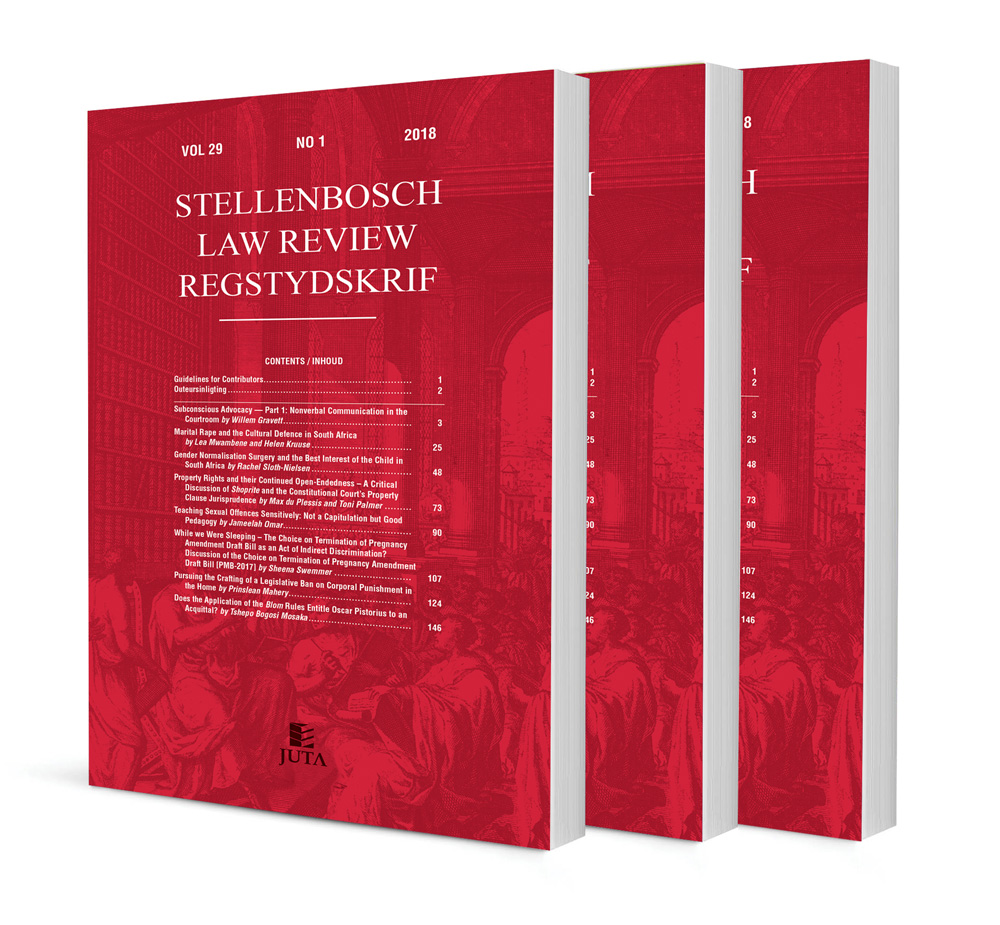
Common-law review, consensus and quantum leaps [discussion of Trustees for the time being of the Legacy Body Corporate v BAE Estates and Escapes (Pty) Ltd 2022 1 SA 424 (SCA)]

Author: DM Pretorius

ISSN: 1996-2193
Affiliations: BA (Hons) LLB LLM PhD Partner: Bowmans, Johannesburg
Source: Stellenbosch Law Review, Volume 33 Issue 4, 2022, p. 690-702
https://doi.org/10.47348/SLR/2022/i4a7

Abstract

The judgment in Trustees for the Time Being of the Legacy Body Corporate v Bae Estates and Escapes (Pty) Ltd 2022 1 SA 424 (SCA) explores aspects of judicial review of decisions made by private organisations in the exercise of private power. In particular, the judgment addresses the reviewability of such decisions for want of compliance with the rules of natural justice. At common law, courts will review disciplinary proceedings of private bodies to ensure compliance with natural justice. Whether or not the rules of natural justice find application in non-disciplinary proceedings of a private body depends on its internal contractual arrangements. The judgment under discussion fails to engage adequately with the relevant common-law principles, resulting in an unconvincing decision that obfuscates rather than clarifies the legal position in this regard.

Re-thinking the “pillar paradigm” for sustainable development: An analysis of the Bo-Kaap Case reveals a shift to simple proportionality … and the fact that deference is not dead after all [discussion of Bo-Kaap Civic & Ratepayers Association v The City of Cape Town 2020 2 ALL SA 330 (SCA)]

Re-thinking the “pillar paradigm” for sustainable development: An analysis of the Bo-Kaap case reveals a shift to simple proportionality … and the fact that deference is not dead after all [Discussion of Bo-Kaap Civic & Ratepayers Association v The City
of Cape Town 2020 2 All SA 330 (SCA)]

Author: Lauren Kohn

ISSN: 1996-2193
Affiliations: B Bus Sci LLB LLM & Young Research Fellow (University of Cape Town) Senior Lecturer, University of Cape Town
Source: Stellenbosch Law Review, Volume 33 Issue 4, 2022, p. 703-722
https://doi.org/10.47348/SLR/2022/i4a8

Abstract

This article crystalises and critiques the reasoning of the Supreme Court of Appeal judgment in Bo-Kaap Civic & Ratepayers Association v The City of Cape Town 2020 2 All SA 330 (SCA) (“Bo-Kaap”). It does so against the backdrop of the environmental right in section 24 of the Constitution and its animating touchstone of “sustainable development”. In particular, it is argued that Bo-Kaap reveals that the “pillar paradigm” for elucidating and ensuring sustainability is outdated and doctrinally unhelpful. Instead, sustainability is best considered, and attained, through simple proportionality and thus the balancing of factors – including cultural concerns, such as heritage – in a context-responsive manner. Furthermore, the judgment is a significant, if somewhat flawed, one on the matter of deference in the context of reviewing the decisions of actors that exercise public powers. It cautions against judicial overzealousness where the separation of powers looms large and, as in the context of Bo-Kaap, where administrative efficiency and the developmental agenda is at stake. Furthermore, the judgment simultaneously reveals the power (and importance) of socio-economic-rights litigation (and internal appeal procedures) in enhancing participatory, responsive, and thus more accountable, governance. Bo-Kaap concerned a public-interest matter but was litigated – as per the court – to vindicate personal proprietary interests. The case is therefore also interesting insofar as the court refused to apply the principle in Biowatch Trust v Registrar, Genetic Resources 2009 6 SA 232 (CC) on cost-awards where constitutional litigation is concerned. While the judgment has laudable features, and ultimately shines a redeeming light on the (enhanced) actions of the state decision-makers in ensuring sustainable development, it may equally prove to have a chilling effect on public-interest litigation.

Hate speech and mass atrocities [discussion of Prosecutor v Vojislav Šešelj (Trial Chamber III) IT-03-67-T (31 March 2016)]

Hate speech and mass atrocities [discussion of Prosecutor v Vojislav Šešelj (Trial Chamber III) IT-03-67-T (31 March 2016)]

Author: Avitus A Agbor

ISSN: 1996-2193
Affiliations: LLB (Hons) LLM PhD, Research Professor of Law, Faculty of Law, North-West University
Source: Stellenbosch Law Review, Volume 33 Issue 4, 2022, p. 723-739
https://doi.org/10.47348/SLR/2022/i4a9

Abstract

Even though there is extensive legal literature on the culpability of authors of hate speech that results in mass atrocities, it remains indisputable that the prosecution of hate speech in international criminal tribunals is still riddled with legal complexities. The recent decision of the Trial Chamber of the International Criminal Tribunal for the former Yugoslavia in the case of Prosecutor v Vojislav Šešelj (Trial Chamber III) IT-03-67-T (31 March 2016) (“Šešelj”) brings to life the view that we are not only getting deeper in the legal maze but far from laying this issue to eternal rest. The decision to acquit the accused because of the prosecution’s failure to prove beyond reasonable doubt that his speeches had led to the atrocities for which he was charged, evoked the element of causation. In application, that view would resonate squarely with the “but for” test which is one of the pillars of the element of causation in criminal law. Steering away from a doctrinal discussion of the merits of the “but for test”, this contribution critiques the Trial Chamber’s judgment in the Šešelj case: taking an evidence-based approach that examines the culpability for hate speech prior to the Šešelj decision, the contribution explores the underlying theoretical and jurisprudential flaws in the Šešelj judgment.