The Choice Principle After Absa: Does the Modern GAAR Compel Taxpayers to Pay the Most Tax? A Critical Analysis of the Tax Court Judgment in Company AF and Others v Commissioner for SARS
The Choice Principle After Absa: Does the Modern GAAR Compel Taxpayers to Pay the Most Tax? A Critical Analysis of the Tax Court Judgment in Company AF and Others v Commissioner for SARS
Authors: Matthew Blumberg SC and Michael Rudnicki
ISSN: 2219-1585
Affiliations: N/A
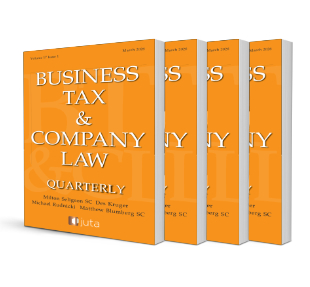
Source: Business Tax & Company Law Quarterly, Volume 17 Issue 3, 2025, p. 1 – 15
Abstract
In April 2026 the Constitutional Court delivered its landmark judgment in Absa Bank Ltd and Another v Commissioner for the South African Revenue Service, the first authoritative interpretation of the post-2006 general anti-avoidance rules in sections 80A to 80L of the Income Tax Act 58 of 1962. Three months later, the Tax Court in Cape Town applied those principles in Company AF and others v Commissioner for SARS, a case involving seven corporate appellants that sold their shareholding in a self-storage property company through a four-step dividend-and-subscription structure which had the effect of converting taxable capital gains into exempt inter-company dividends. This article recaps the key holdings in Absa, including the objective sole-or-main purpose enquiry, the expanded definition of ‘party’, and the counterfactual comparator for determining tax benefit. It then provides a detailed analysis of the Tax Court judgment – its application of Absa, the tax benefit finding, and the treatment of the Conhage choice principle. The article advances a critical thesis: that section 80G of the Income Tax Act is an evidentiary presumption and objective-purpose provision, not a statutory mandate to pay the most tax. It argues that the choice principle affirmed in Conhage survives Absa and retains real content (though subject to the constraints built into the choice principle itself). The GAAR should not be read as compelling taxpayers to select, from amongst various legitimately available paths to achieving a given commercial objective, that which is fiscally the costliest. The article concludes with practical implications for structuring transactions in light of these developments.