Intellectual Property as Real Security

Intellectual Property as Real Security

Authors Sadulla Karjiker

ISSN: 2521-2591
Affiliations: Anton Mostert Chair of Intellectual Property Law, Faculty of Law, Stellenbosch University
Source: South African Intellectual Property Law Journal, 2018, p. 1 – 23

Abstract

None

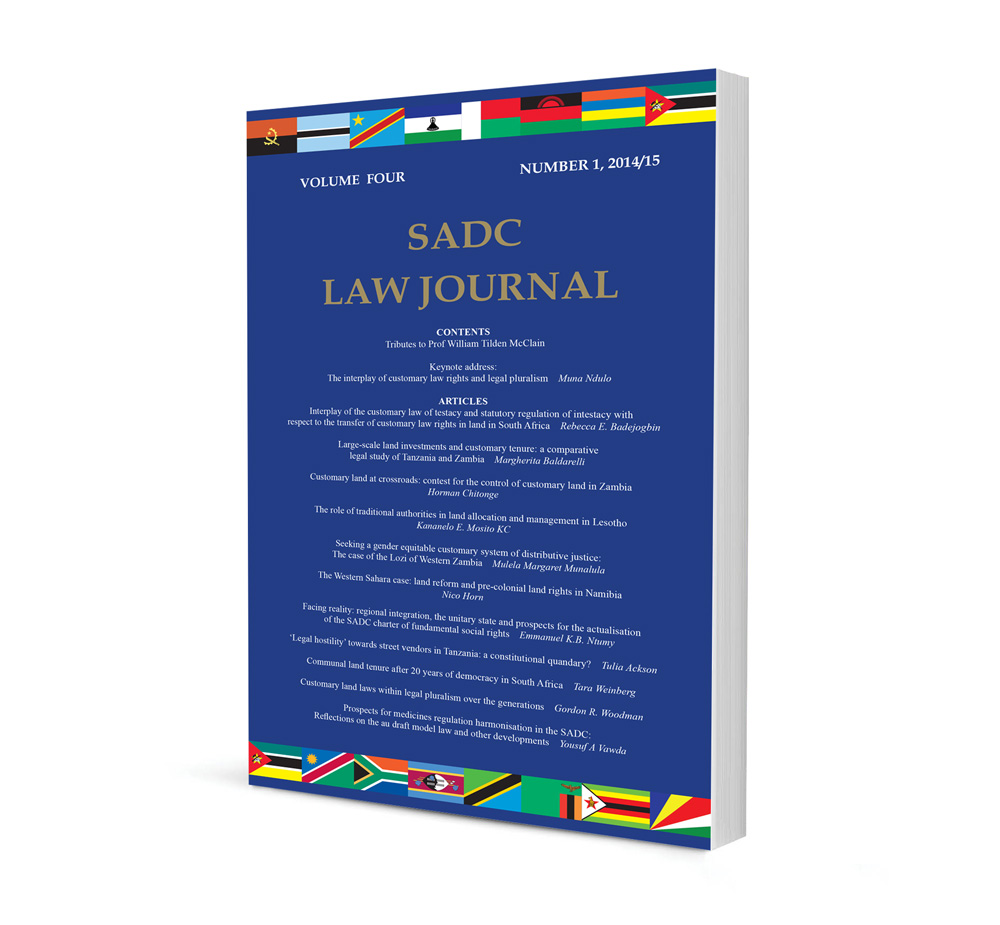
The Interplay of Customary Law Rights and Legal Pluralism

The Interplay of Customary Law Rights and Legal Pluralism

Authors Muna Ndulo

ISSN: 2026-8556
Affiliations: Professor of Law, Elizabeth and Arthur Reich Director, Leo and Arvilla, Berger International Legal Studies Program, and Director of the Institute for African Development Cornell University
Source: SADC Law Journal, The, 2014/15, p. 1 – 9

Abstract

None

Law Enforcement Responses Facilitated by a Fisheries Crime Approach: The South African Example

Law Enforcement Responses Facilitated by a Fisheries Crime Approach: The South African Example

Authors Emma Witbooi, Phil Snijman

ISSN: 2521-5442
Affiliations: PescaDOLUS International Fisheries Crime Research Initiative; Extraordinary Lecturer, Centre for Environmental Studies, University of Pretoria
Source: Journal of Ocean law and Governance in Africa (iilwandle zethu), 2017, p. 1 – 55

Abstract

In line with international developments, South Africa is in the grips of recasting its understanding of illegal fishing as a potential form of fisheries crime that is frequently transnational and organised. This unlocks the use of a number of previously untapped law enforcement tools in the domestic and international criminal law and procedure sphere towards addressing the problem. This article extrapolates these tools in the context of surveying possible South African law enforcement responses relating to fisheries crime from both a legislative (theoretical) and a practical perspective with reference to recent case law trends.

Enforcement actions: The Registrar of Financial Services Providers and the Financial Services Board v Aegis Outsourcing (Pty) Ltd – Case No 1/2018

Enforcement actions: The Registrar of Financial Services Providers and the Financial Services Board v Aegis Outsourcing (Pty) Ltd – Case No 1/2018

Authors Daleen Millard

ISSN: 2517-9543
Affiliations: Department of Private Law, Law Faculty, University of Johannesburg
Source: Juta’s Insurance Law Bulletin, Volume 22 Issue 1, 2019, p. 1

Abstract

None

A Critique of the Exclusion of the Application of the Solvency and Liquidity Test on Appraisal Rights

A Critique of the Exclusion of the Application of the Solvency and Liquidity Test on Appraisal Rights

Authors Simphiwe S Bidie

ISSN: 2521-2575
Affiliations: Lecturer, Nelson R Mandela School of Law, University of Fort Hare
Source: Journal of Corporate and Commercial Law & Practice, The, Volume 4 Issue 2, 2018, p. 1 – 30

Abstract

In recent times the protection of minority shareholders has received quite a lot of attention in corporate governance. This is especially so now that corporate reforms abound. The development of the appraisal remedy has been a means towards the protection of such shareholders. These rights have been occasioned by the relentless contests, which companies are often inundated with, between majority and minority shareholders. Recently, appraisal rights have found expression in legislative frameworks of several countries to accord protection to minority shareholders. In South Africa, the Companies Act 71 of 2008 accords appraisal rights to minority shareholders. Under s 164 of the Act, when minority shareholders opt to exercise appraisal rights by, for example, making a demand to be paid by the company for their shares, those payments are excluded from constituting distribution by the company or the acquisition of shares by a company within the meaning of s 48 of the Act, and as such the payment is exempted from the operation of the provisions of s 48 or the application of the solvency and liquidity test set out in s 4 of the Act. The purpose of this paper is to critically engage with the exemption of a company from the scrutiny of the solvency and liquidity test because of payments made to minority shareholders occasioned by the exercise of appraisal rights.