
Reconciling the Notion of Sovereignty with SADC’s Human Rights Protection Mandate

Reconciling the Notion of Sovereignty with SADC’s Human Rights Protection Mandate
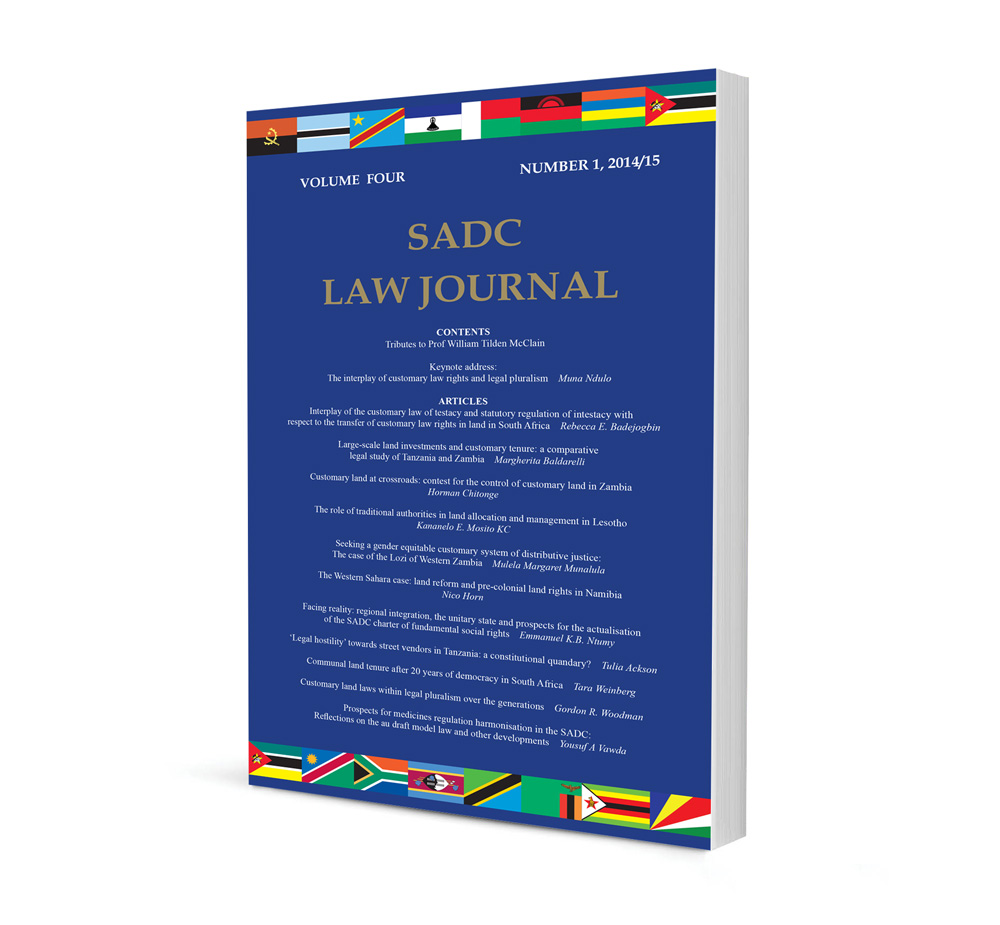
Authors Obonye Jonas

ISSN: 2026-8556
Affiliations: Lecturer, Law Department, University of Botswana Practising Attorney with Jonas Attorneys
Source: SADC Law Journal, The, 2013, p. 212 – 237

Abstract

Sovereignty and human rights are seemingly fundamentally opposed notions. Obligations to protect human rights are thus regularly perceived as besieging or assaulting or contradicting state sovereignty. This understanding of the relationship between sovereignty and human rights is the subject of common lament, especially among human rights scholars. They challenge strict legalism that views sovereignty as entitling states to non-interference in their internal affairs. However, legal pragmatism and international relations have propelled states towards cooperation for the establishment of an international comity. In furtherance of this cooperation, especially at multilateral level, states have preferred the creation of specialised international or regional institutions for the realisation of set goals. The SADC is one such regional institution. Though formed to foster regional integration and spur economic growth in Southern Africa, it also has a human rights protection mandate. Owing to its slavish adherence to the venerable doctrine of state sovereignty (in its traditional form), the SADC, as a body or its members countries have on numerous occasions failed to intervene in territories of other member states to protect human rights of citizens. Where it did intervene as it did in Madagascar and Zimbabwe, it has done so in a carefully measured way so as to amount to no intervention at all. This article argues that the reformulation of the notion of sovereignty as by influenced notions of human rights has left states no less sovereign than they were during the time of Aristotle, several decades ago. Far from undermining sovereignty, human rights are embedded in sovereignty itself. In statehood, both sovereignty and human rights have found space and they must coexist. None of the two must be undermined in favour of the other. Legal and political practices demand this to be so.

Evolving Regional Standards on the Rights of Labour Migrants: Perspectives from the EAC and the SADC

Evolving Regional Standards on the Rights of Labour Migrants: Perspectives from the EAC and the SADC

Authors Juliana Masabo

ISSN: 2026-8556
Affiliations: Lecturer, University of Dar es Salaam School of Law
Source: SADC Law Journal, The, 2013, p. 182 – 211

Abstract

Labour migration is a fundamental element in fostering African economic integration process. Yet, issues related to intra-regional mobility and regional citizenship continue to be severely constricted. Intra-regional labour mobility is heavily balanced against the competing and conflicting political and economic interests of individual states. Most of countries in the region do not subscribe to the existing international instruments on labour migration and their record in this area is generally poor. Marginalisation of migrants is widespread in most African countries. The East African Community (EAC) and the Southern African Development Community (SADC), being among the sub-regions with higher proportions of intra-regional labour mobility, have responded by formulating new policies and legal instruments. These are aimed to facilitate regularised movements of people across the borders and thereby maximise the potential economic benefits flowing from these movements. This contribution examines the extent to which the human rights of migrants are perceived and integrated in the EAC and SADC legal and policy framework. The relevant instruments are analysed in the context of the prevailing socio-economic situation thereby identifying the critical legal issues and gaps and the implementation challenges. It is argued that, although some positive strides in protecting the rights of migrants in the EAC and the SADC have been achieved, there are several outstanding challenges which require urgent action.

Effectiveness of Flexible Land Tenure in Unplanned Urban Areas in the SADC Region: A Case Study of Tanzania and Experiences from Zambia and Namibia

Effectiveness of Flexible Land Tenure in Unplanned Urban Areas in the SADC Region: A Case Study of Tanzania and Experiences from Zambia and Namibia

Authors Kennedy Gastorn

ISSN: 2026-8556
Affiliations: Senior Lecturer, University of Dar es Salaam School of Law
Source: SADC Law Journal, The, 2013, p. 160 – 181

Abstract

The Southern Africa Development Community (SADC) region is one of the fastest urbanising regions in which a majority of its urban and peri-urban dwellers are extra-legal, in that they do not have clear formal titles of land tenure to their land. Expansion of town boundaries occurs without an increase in basic and essential social services, such as the surveying and servicing of plots. Increasingly, states in the region are devising new forms of land tenure as alternatives to the existing tenures, collectively referred to as flexible land tenures, as a way of addressing land tenure insecurity within urban and peri-urban areas but also to economically empower the residents. This paper discusses the legal implications of flexible land tenures on land tenure security within the SADC region using Tanzania as a focal point. Specifically, it discusses the residential licences of Tanzania in the prism of occupancy licences of Zambia and starter and landhold titles of Namibia. It argues that these tenures are temporary and remedial in nature. As much as they have the potential to afford limited tenure security and contribute to economic growth, if not properly managed they might encourage more squatting and informal settlements. This contribution therefore provides a legal and policy framework upon which these licences are issued, the procedures, and the consequences that are attached to the licence holder. Also the relation between the licence and the future of unplanned settlements is discussed based on the overriding question whether such schemes are more for tenure security or urban planning. It is assumed that urbanisation is the major cause of the unplanned settlements.

Sub-Saharan Africa and Climate Change: Revisiting the ‘Multiple Stresses’ Factor and Adaptation Strategies of ECOWAS and SADC zones

Sub-Saharan Africa and Climate Change: Revisiting the ‘Multiple Stresses’ Factor and Adaptation Strategies of ECOWAS and SADC zones

Authors Yemi Oke

ISSN: 2026-8556
Affiliations: Senior Lecturer at the Faculty of Law, University of Lagos, Nigeria
Source: SADC Law Journal, The, 2013, p. 139 – 159

Abstract

Global consensus on climate change governance has proved difficult due to dwindling commitments to a binding accord. A new thinking is beginning to emerge in the developing countries that regional, as against global actions, would meet the exigency of climate change mitigation and adaptation particularly in sub-Saharan Africa. This article examines the challenge of climate change mitigation and adaptation in Africa particularly the impact of multiple stresses concept on adaptive capabilities of countries in the Southern African Economic Development Community (‘SADC’) and the Economic Community of West African States (‘ECOWAS’) zones. It advocates decentralised climate change governance through the intensification of concerted efforts and initiatives by countries in the region in curtailing the ‘multiple stress’ factors to climate change. The argument of this paper draws on the weaknesses and strengths of international climate change law in a bid to strengthening the argument for decentralised climate change governance through regional initiatives.

Joint Management as an Emerging Norm in International Watercourses Law: The Case of the SADC

Joint Management as an Emerging Norm in International Watercourses Law: The Case of the SADC

Authors William Attwell

ISSN: 2026-8556
Affiliations: Principal Policy Analyst, City of Cape Town
Source: SADC Law Journal, The, 2013, p. 117 – 138

Abstract

This article examines how the joint management approach to the governance of international watercourses — and its institutional expression: the international river basin organisation or IRBOs — is gaining traction as a norm in international watercourses law in the context of the SADC’s legal and policy architecture. It posits that, in response to the acute water insecurity facing the region, SADC member states have increasingly moved towards an integrated approach to international watercourses law and governance, one that places a strong emphasis on trans-boundary joint management regimes. This is underpinned by legal developments at international, regional and national levels. At an international level, the SADC member states that are party to the UN Convention on the Law of the Non-navigational Uses of International Watercourses have committed to the principles of equitable and reasonable utilisation, as well as provisions promoting the establishment of joint institutions. This has shaped regional international law, notably the 2000 SADC Protocol on Shared Watercourses, with its emphasis on institutional cooperation; as well as the attendant SADC policy documents shaping trans-boundary water governance. The article uses a case study of the Okavango states (Angola, Botswana and Namibia) to assess how the concept of joint management of trans-boundary watercourses has been incorporated into water law at a national level. The paper concludes by examining developments in contemporary international jurisprudence regarding the joint management concept and joint institutions by analysing two cases where the role of such institutions became a prominent theme in judgments handed down by the International Court of Justice.