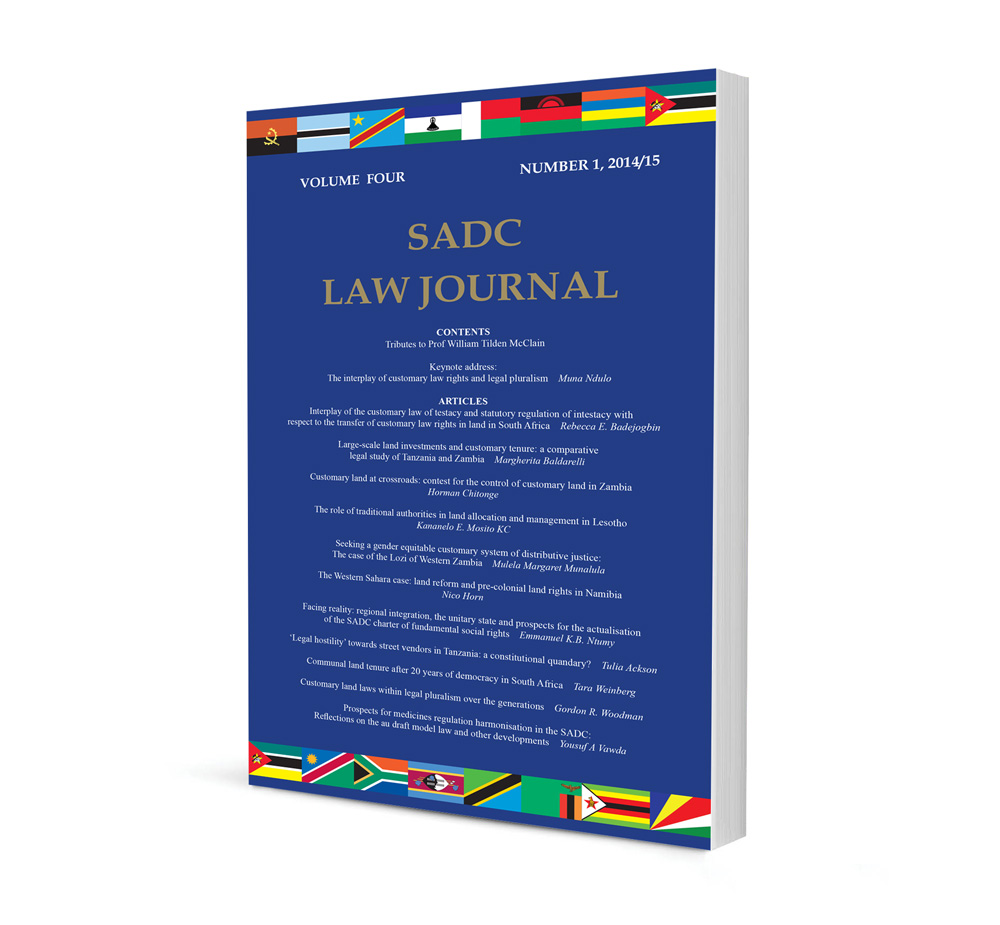
Climate change policy positions and related developments in the AU and SADC

Climate change policy positions and related developments in the AU and SADC

Authors Oliver C Ruppel

ISSN: 2026-8556
Affiliations: Professor of Law, Faculty of Law, University of Stellenbosch, South Africa
Source: SADC Law Journal, The, 2012, Issue 1, p. 14 – 35

Abstract

Both the African Union (AU) and the Southern African Development Community (SADC) have embarked on new policy pathways to accommodate climate change more effectively in future. These pathways and recent developments such as the Tripartite Initiative and the BRICS Partnership between Brazil, Russia, India, China and South Africa are reflected on as they are not only deemed to become more and more relevant in a changing climate, but at the same time promise to enfold potential and new opportunities for economic and sustainable development for Africa on regional and sub-regional levels. It is the objective of this article to discuss these new policy pathways and related developments and, where possible, assess their potential benefit. While doing so, the article reflects on legal and institutional structures, some relevant cases, contemporary and future challenges, and developmental perspectives pertinent to the issue of climate change and the African continent.

Does SADC provide a Remedy for Environmental Rights Violations in Weak Legal Regimes? A case Study of Iron Ore Mining in Swaziland

Does SADC provide a Remedy for Environmental Rights Violations in Weak Legal Regimes? A case Study of Iron Ore Mining in Swaziland

Authors Angelo Dube

ISSN: 2026-8556
Affiliations: Lecturer, Department of Public Law and Jurisprudence, Faculty of Law, University of the Western Cape
Source: SADC Law Journal, The, 2013, p. 259 – 278

Abstract

Environmental protection and economic advancement are two goals that require careful balancing by any government. This is often achieved through the creation of domestic, regional and international legal frameworks, aimed at ensuring that aggrieved individuals whose environmental and other fundamental rights are violated are offered an avenue to seek remedies. The Southern African Development Community (SADC) was created for such purposes, and its Tribunal was set up to hear and determine disputes between states and between states and a private person. This jurisdiction to determine matters brought by natural and juristic persons formented the contentions that led to the eventual suspension of the Tribunal, and resolutions to restrict its jurisdiction by excluding the individuals and companies from approaching it. The suspension of the Tribunal, coupled with lack of political will at the domestic level, as well as weak institutions, has allowed powerful multi-national corporations in weak legal regimes such as Swaziland to violate environmental rights with impunity. The mining of iron ore within a nature reserve in Swaziland and flaws within the environmental impact assessment process followed illustrate the disregard for environmental rights that is prevalent in weak legal regimes. The decision of SADC states to suspend the Tribunal with a view to eventually limit its jurisdiction to disputes between states only basically meant that there is no remedy for violations occurring in such weak states. The gains made in the successful enforcement of the Tribunal’s orders against a member state in the courts of a foreign state in the latest South African Constitutional Court Case have, unfortunately come a bit late. Without access to the Tribunal for disputes involving natural and juristic persons, SADC does not offer remedies to aggrieved individuals.

The Prospect of SADC-Parliamentary Forum Transformation into a Regional Parliament: Too Big too Soon?

The Prospect of SADC-Parliamentary Forum Transformation into a Regional Parliament: Too Big too Soon?

Authors Dennis U Zaire

ISSN: 2026-8556
Affiliations: Programme Officer, Konrad Adenauer Foundation – Namibia & Angola Office
Source: SADC Law Journal, The, 2013, p. 238 – 258

Abstract

The Southern African Development Community Parliamentary Forum (SADC-PF) [fn1], a regional consultative forum, has embarked on a transformation process to become a fully functioning regional parliament, to be called the SADC Parliament. [fn2] The transformation is necessitated by the need to meet modern demands and keep pace with the ever-changing world. As a regional parliament, the SADC-PF would contribute to regional matters and influence national parliaments more effectively on regional issues than is currently the case. At the moment the SADC does not have a fully-fledged regional parliament like the East African Legislative Assembly (EALA) of the East African Community (EAC) or the Economic Community of West African States (ECOWAS) Parliament. Instead, it has a Parliamentary Forum that has no legislative powers and limited influence in the region. A regional parliament will also help bring SADC closer to the people and vice versa [fn3] through the provision of a platform for the participation of the people through law making and outreach. However, the road to the realisation of that goal is filled with uncertainties and more questions than answers. Is the time right for the establishment of a regional parliament? In fact, does the southern African region need a regional parliament or is the idea of SADC Parliament ill-conceived? [fn4] Does the SADC have the capacity, in terms of financial, as well as human resources to accommodate a regional parliament, and if so, where will it be based [fn5] and what would be its relationship with the member’s national Parliaments? The question beckons what value the SADC Parliament will bring to the ordinary citizen. With these questions in mind, it is the objective of this paper to look closely at the idea of SADC Parliament while discussing the issues involved in the formation of the SADC Parliament. The article will, therefore, briefly reflect on the achievements of the SADC-PF over the last fifteen years (1997—2012), looking at the current challenges faced by the institution and the future opportunities that await the institution. It will also, where appropriate, refer to other regional parliamentary structures, to help in analysing whether the idea of a SADC Parliament is fitting for the region. footnote 1: Founded on 8th September 1997, in Blantyre, Malawi. footnote 2: SADC-PF preamble states: We, the representative of the people of the Southern African Development Community, having solemnly resolved to constitute a Consultative Parliamentary Assembly to be known as the Southern African Development Community Parliamentary Forum with a view to developing into a regional parliamentary structure, for the purpose of strengthening the capacity of the Southern African Development Community by involving parliamentarians of members states in its activities. footnote 3: Article 23 (1) of the SADC Treaty (1992) states: ‘in pursuance of the objectives of this treaty, SADC shall seek to involve fully, the people of the region and Non-governmental organizations in the process of regional integration’. footnote 4: Originally the SADC Treaty did not provide for a regional parliamentary structure. Hence, SADC-PF was created under article 9(2) and not under article 9(1) of the SADC treaty. footnote 5: Currently the SADC-PF is hosted by Namibia. A publication by the SADC-PF refers to the seat of the SADC Regional Parliament to be determined by the SADC Heads of State and Government. See SADC-PF consolidated document, ‘Towards the Establishment of a SADC Parliament’, unpublished at page 7.