
Good corporate governance affirms the board (led by the chairperson) as the focal point of governance and the courts have no mandate to undermine this principle
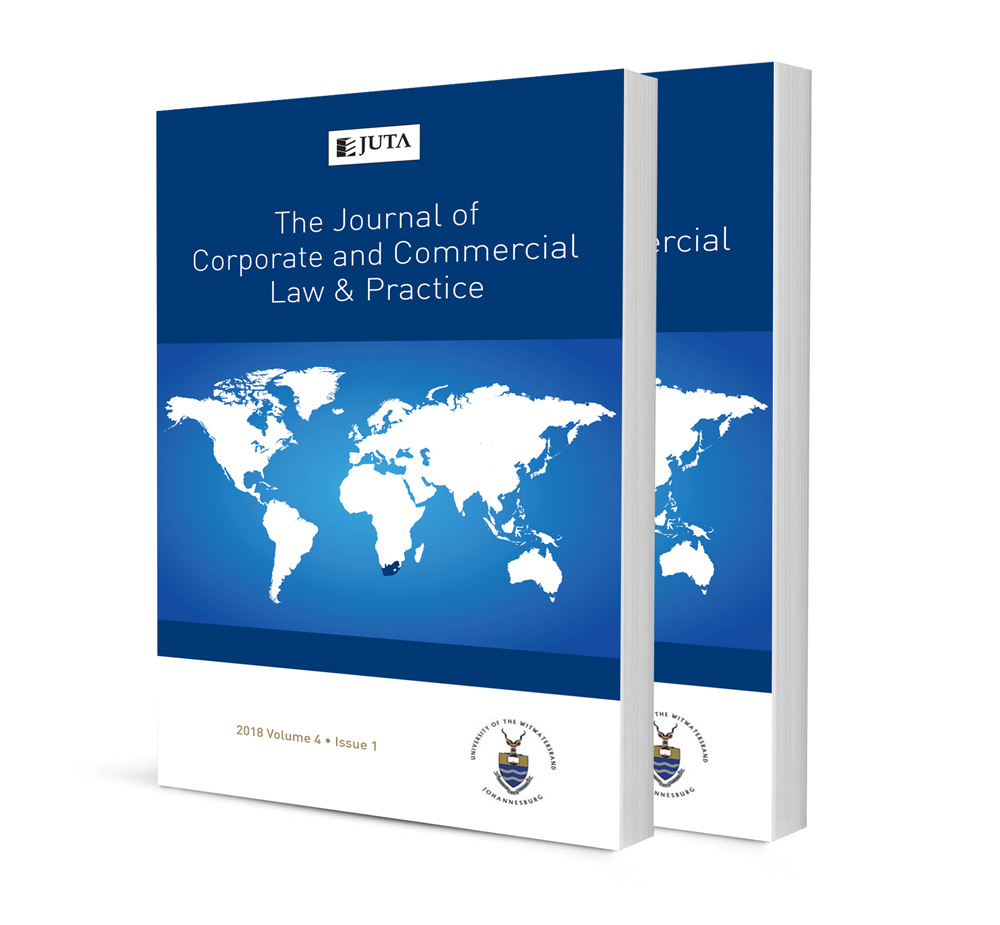
Good corporate governance affirms the board (led by the chairperson) as the focal point of governance and the courts have no mandate to undermine this principle

Authors Tsepiso Mofokeng

ISSN: 2521-2575
Affiliations: Executive Chairman, Mofisto Investments (Pty) Ltd
Source: Journal of Corporate and Commercial Law & Practice, Volume 6 Issue 1, 2020, p. 66 – 79

Abstract

Corporate governance has long been endorsed globally as a key  factor in the survival or success of every corporation. The failure  of international companies like Arthur Anderson and Enron serves  to reinforce the argument that the courts have a role to play in  circumstances where the board has failed to carry out its functions.  This will be argued by referring to the importance of the prescribed  legislation and the King Codes, and more specifically, King IV as a  watchdog of good governance, often cited in court decisions where  governance is in issue. Reference will also be made to relevant case  law to emphasise the role of the courts in this regard. 
Befriending the bogeyman: Direct horizontal application in AB v Pridwin

Befriending the bogeyman: Direct horizontal application in AB v Pridwin

Author Meghan Finn

ISSN: 1996-2177
Affiliations: Lecturer in Public Law, University of Johannesburg
Source: South African Law Journal, Volume 137 Issue 4, p. 591-607

Abstract

In AB v Pridwin Preparatory School 2020 (5) SA 327 (CC), the Constitutional  Court held (in four judgments) that independent schools are subject to constitutional  scrutiny and bear duties to the learners enrolled in them. For this reason, the court  declared invalid a school’s decision to terminate a contract without affording any  opportunity to make representations. By rejecting the idea that the independent  schooling sector is insulated from constitutional duties, the Constitutional Court’s  judgment achieves a vital outcome. However, while the court’s outcome is welcome,  its reasoning rests on shaky foundations. The court’s majority, which favoured direct  horizontal application, inadvertently perpetuates the idea that there are parallel  systems of law. Further, the court has a great appetite for making sweeping legal  pronouncements, and then purportedly limiting their precedential effects by claiming  that judgments turn on context-specific inquiries. This cuts against the court’s stated  commitment that horizontal application must progressively transform the law. 

‘When legality and certainty collide’: Magnificent Mile Trading 30 (Pty) Ltd v Celliers NO & others

‘When legality and certainty collide’: Magnificent Mile Trading 30 (Pty) Ltd v Celliers NO & others

Author D M Pretorius

ISSN: 1996-2177
Affiliations: Bowmans, Johannesburg
Source: South African Law Journal, Volume 137 Issue 4, p. 608-624

Abstract

Magnificent Mile Trading 30 (Pty) Ltd v Celliers NO & others 2020 (4)  SA 375 (CC) is the latest in a line of cases in which the Constitutional Court has  had to consider the effect of the decision in Oudekraal Estates (Pty) Ltd v City of  Cape Town 2004 (6) SA 222 (SCA). The Oudekraal case has been construed,  and is frequently invoked, as authority for a broad proposition that defective and  apparently unlawful administrative acts remain effective unless and until set aside on  judicial review. In several matters, the Constitutional Court bench has been split on  the impact of Oudekraal, and has expressed itself in abstruse terms. The resultant  confusion has created uncertainty. The Magnificent Mile decision provides a degree  of clarification. However, aspects of Oudekraal and its implications remain shrouded  in uncertainty. Cases decided in the Oudekraal context would benefit from closer  scrutiny of the enabling legislation of the administrative actors concerned. 

Caveat subscriptor, the consumer-friendly approach: An analysis of Van Wyk v UPS SCS South Africa (Pty) Ltd

Caveat subscriptor, the consumer-friendly approach: An analysis of Van Wyk v UPS SCS South Africa (Pty) Ltd

Author Tshepiso Scott

ISSN: 1996-2177
Affiliations: Lecturer, Department of Mercantile Law, University of Pretoria
Source: South African Law Journal, Volume 137 Issue 4, p. 625-640

Abstract

Prior to the Consumer Protection Act 68 of 2008 (‘CPA’), the consumer in South  Africa was without substantive protection when concluding contracts with suppliers.  This case note explores how the CPA has changed this position by the introduction  of information-disclosure requirements in terms of s 49 of the Act (‘notice required  for certain terms and conditions’) and the important link to s 22 of the Act, which  affords the consumer the right to information in plain and understandable language.  The recent judgment in Van Wyk v UPS SCS (Pty) Ltd [2020] 1 All SA 857  (WCC) is a long-awaited decision that provides clarity on aspects of the disclosure  requirements that have been prescribed by the Act. 

Beadica 231 CC: An end to the trilogy?

Beadica 231 CC: An end to the trilogy?

Author Simon Thompson

ISSN: 1996-2177
Affiliations: Teaching Assistant, Department of Private Law, University of Cape Town
Source: South African Law Journal, Volume 137 Issue 4, p. 641-658

Abstract

In this note, I consider the path of the Beadica case through the South African court  system. After traversing the relevant law and facts, I focus on the Constitutional  Court’s judgment in Beadica 231 CC v Trustees for the time being of the  Oregon Trust 2020 (5) SA 247 (CC). I conclude that the majority judgment  deserves praise for its pronouncements on several pertinent issues in the law of contract,  namely: the ambit of the Constitutional Court’s judgment in Botha v Rich NO  2014 (4) SA 124 (CC), the importance of the doctrine of precedent, the role of  concepts such as good faith, reasonableness, fairness and ubuntu in the public policy  enquiry, the perceived divergence in approach between the SCA and CC on this  issue, and the court’s application of the law to the facts.