
Staring into voidness — Courts grapple with arbitration clauses in tainted contracts

Staring into voidness — Courts grapple with arbitration clauses in tainted contracts
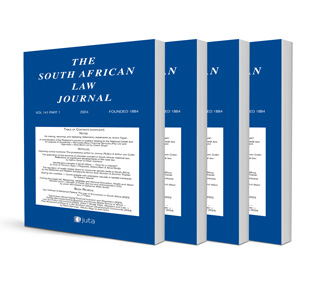
Author: Saleem Seedat

ISSN: 1996-2177
Affiliations: Extraordinary Research Fellow, Faculty of Law, North-West University
Source: South African Law Journal, Volume 141 Issue 1, p. 143-168
https://doi.org/10.47348/SALJ/v141/i1a7

Abstract

Arbitration has a noble lineage that stretches back into time. It has evolved from a simple attempt to resolve disputes in the presence of a local authority to a more technical presentation before an independent arbiter. In South Africa, arbitrations have statutory recognition. This article focuses on an arbitration clause that is embedded in a substantive agreement where the agreement was induced by fraudulent misrepresentation by a party to the agreement. The general principles of the law of contract would dictate that fraud makes the contract voidable at the instance of the innocent party. But our courts have equivocated in deciding whether the tainted contract also besmirches the arbitration clause. While earlier decisions confirmed the autonomy of the arbitration clause, two judgments of the Supreme Court of Appeal (‘SCA’) in particular held that the arbitration clause foundered with the main agreement. The article argues that the SCA’s findings were misconceived and suggests that the SCA’s reluctance to allow arbitrators to decide on the validity of an arbitration clause in a contract instigated by fraud is incorrect. It is argued that consonant with international practice, an arbitration clause should be considered a clause separate from the main agreement that will not be affected by the invalidity of the main agreement. A subsequent SCA decision recognised the primacy of an arbitration clause incorporated into an agreement. The article also proffers the possibility of reading into a contract a tacit term that all disputes arising from the main agreement will be arbitrated.

Footing the (wage) bill: Reasoning, remedies and National Education, Health and Allied Workers Union v Minister of Public Service and Administration (CC)

Footing the (wage) bill: Reasoning, remedies and National Education, Health and Allied Workers Union v Minister of Public Service and Administration (CC)

Authors: Justin Winchester & Catherine Willis-Smith

ISSN: 1996-2177
Affiliations: Bachelor of Civil Law candidate, Faculty of Law, University of Oxford; Teaching Assistant, Department of Public Law, University of Cape Town
Source: South African Law Journal, Volume 141 Issue 1, p. 169-200
https://doi.org/10.47348/SALJ/v141/i1a8

Abstract

In NEHAWU & others v Minister of Public Service and Administration & others 2022 (6) BCLR 673 (CC), the Constitutional Court declared invalid and unenforceable a clause regulating the third payment period in a collective agreement regulating periodic wage increases for public service employees. We do not take issue with the court’s findings concerning the validity of the impugned collective agreement. However, we question the reasoning provided for the ‘just and equitable’ remedy ordered. We find the court’s reasoning insufficient in so far as it overlooked applicable principles of corrective justice, the significance of the state being unjustifiably enriched by labour peace by curtailing public servants’ right to strike, and the consequences of its decision on the effectiveness of the delay-bar in preventing ill-motivated state self-review. We propose the bifurcated approach that the court adopted in the AllPay saga as a tool to adjudicate polycentric cases such as the impugned case, as it enhances the judiciary’s proper place in the separation of powers and maximises remedial possibilities for innocent third parties to state contracts. We conclude with what has happened on the ground since this decision was reached.

Ogochukwu Monye Digital Financial Inclusion and Regulation (2023); Oyeniyi Abe Implementing Business and Human Rights Norms in Africa — Law and Policy Interventions (2022); Victor T Amadi Trade, Migration and Law — Free Movement of Persons in the Southern African Development Community (2024)

BOOK REVIEW

Ogochukwu Monye Digital Financial Inclusion and Regulation (2023); Oyeniyi Abe Implementing Business and Human Rights Norms in Africa — Law and Policy Interventions (2022); Victor T Amadi Trade, Migration and Law — Free Movement of Persons in the Southern African Development Community (2024)

Authors: Raisa Nyirongo, Yakubu Nagu & Ada Ordor

ISSN: 1996-2177
Affiliations: University of Cape Town
Source: South African Law Journal, Volume 141 Issue 1, p. 205-211
https://doi.org/10.47348/SALJ/v141/i1a10

Abstract

None

Prescient precedent: PAF v SCF (SCA) and a new paradigm for testing whether a trust has been abused to manipulate a spouse’s accrual (or redistribution) liability at divorce

NOTE

Prescient precedent: PAF v SCF (SCA) and a new paradigm for testing whether a trust has been abused to manipulate a spouse’s accrual (or redistribution) liability at divorce

Author: Bradley S Smith

ISSN: 1996-2177
Affiliations: Senior Lecturer: Research, The Independent Institute of Education’s Varsity College; Extraordinary Professor of Private Law, University of the Free State
Source: South African Law Journal, Volume 140 Issue 4, p. 697-714
https://doi.org/10.47348/SALJ/v140/i4a1

Abstract

In this note, I argue that PAF v SCF 2022 (6) SA 162 (SCA) is a groundbreaking judgment for curbing the abuse of the trust form by spouses who are married out of community of property and who engage in unscrupulous ‘divorce planning’ aimed at manipulating their personal estate values for the purposes of dividing matrimonial property at divorce. PAF not only removes several uncertainties regarding our courts’ ability to pierce the veneer of an abused trust but also broadens our conventional understanding of what trust-form abuse entails in the divorce setting, particularly by virtue of its engagement with the SCA’s earlier (prescient) judgment in Badenhorst v Badenhorst 2006 (2) SA 255 (SCA). In the process, I argue that there is a need to reconsider the test formulated in REM v VM 2017 (3) SA 371 (SCA) for taking the asset value of an alter-ego trust into account for accrual claims at divorce. I further assert that the new paradigm PAF ushers in requires formulating a consolidated test that takes into account this reconsideration, as well as the novel factual matrix in PAF. I conclude that this consolidated test is not only capable of being applied in the context of accrual liability, but also where a spouse is eligible to seek a redistribution order in terms of s 7 of the Divorce Act.

Progressive, yet problematic: Unpacking the therapy order and sentence in S v SN

NOTE

Progressive, yet problematic: Unpacking the therapy order and sentence in S v SN

Author: Delano Cole van der Linde

ISSN: 1996-2177
Affiliations: University of Cape Town
Source: South African Law Journal, Volume 140 Issue 4, p. 715-732
https://doi.org/10.47348/SALJ/v140/i4a2

Abstract

The judgment in S v SN [2022] ZAECGHC 35 is dichotomous as it is both progressive and problematic. The judgment is progressive as, for the first time, a South African criminal court imposed a therapy order for a victim of rape. The minor victim in this case was raped multiple times by her uncle in a familial home. The court was further enjoined to impose a minimum life sentence under the Criminal Law Amendment Act 105 of 1997, as the victim was under the age of 16 and had been raped on multiple occasions. However, the court in SN was entitled to deviate from the minimum sentence when ‘substantial and compelling circumstances exist’ to do so. In considering the mitigating and aggravating factors present in the case, the court deviated from the minimum life sentence based on the remorse of the accused and the lack of force used during the rape. The judgment is problematic because considering these factors unearthed problematic narratives surrounding the nature of rape. This note critically analyses the judgment in SN and submits that although the therapy order is a welcome development, the court erred in considering a lack of force employed during the rape as a mitigating factor.