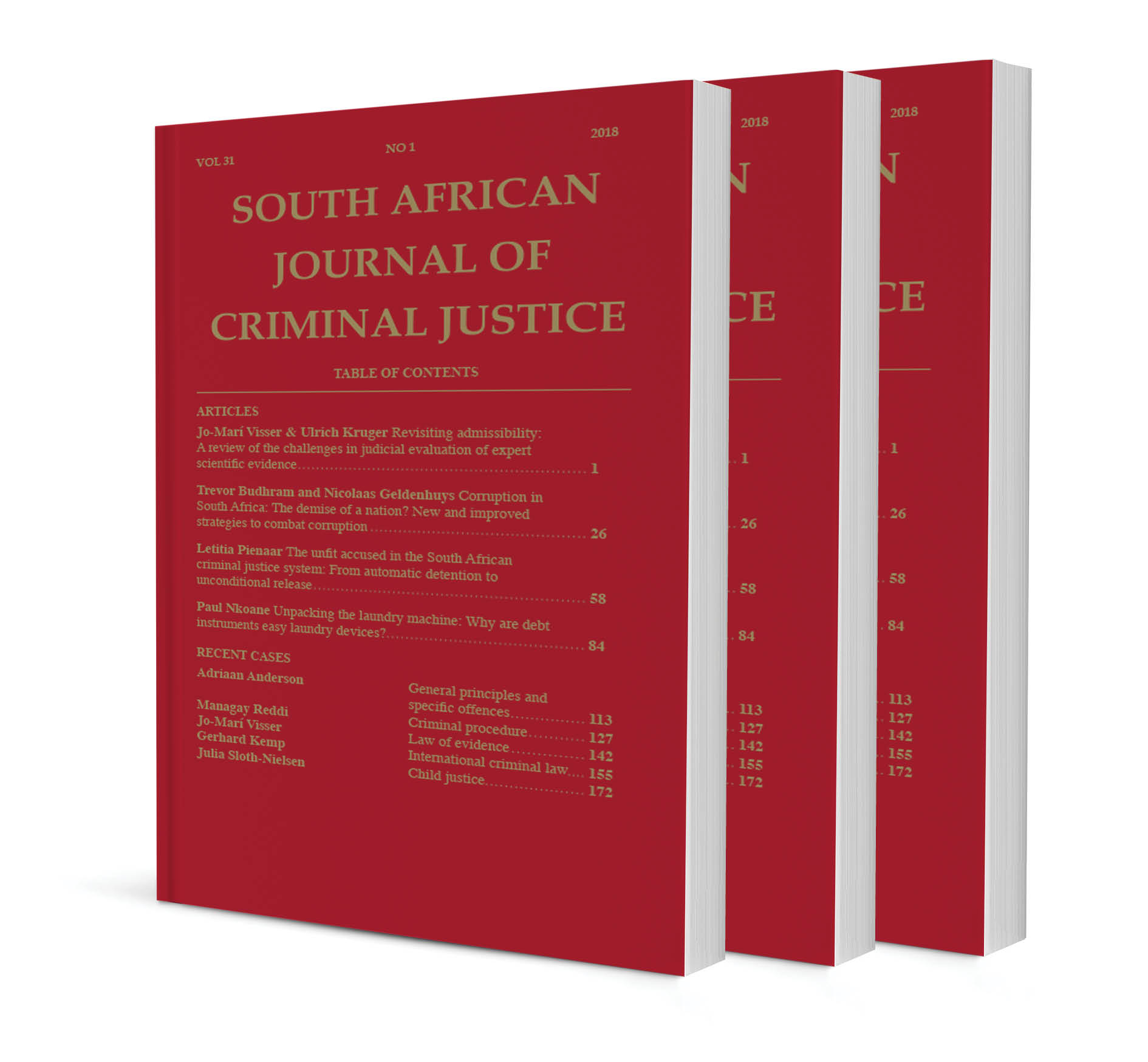
Policing in a failing state: An impossible mission

Policing in a failing state: An impossible mission

Author: David Masiloane

ISSN: 1996-2118
Affiliations: DLitt et Phil (Unisa); Professor, Department of Police Practice, Unisa
Source: South African Journal of Criminal Justice, Volume 37 Issue 1, p. 84 – 102
https://doi.org/10.47348/SACJ/v37/i1a4

Abstract

The political interference and poor governance lead to a weak police service that fails to provide safety and security to communities. This exposes people to crime and criminality and makes them lose trust in the police, compelling them to take the law into their own hands. A weak state paralyses the police, and a paralysed police service reflect a weak state. This study analysed books, articles, and print and electronic media to determine whether South Africa exhibits some of the characteristics of a failing state, and what impact this has on the police and policing in the country. The failure of the state at any level – such as the inability of the National Student Financial Aid Scheme to speedily disburse financial aid to students, municipalities’ incapacity to render services to communities, and the police’s powerlessness in dealing with high crime rates – leads to public discontent, anger and frustration, which tend to be expressed through violent protests. The policing of these protests is often criticised as being either indecisive or brutal, thus presenting a continuous challenge to police leadership on how to strike a sensitive balance between indecisiveness and brutality.

The Prosecutor v Dominic Ongwen case before the International Criminal Court: A Twail-er’s perspective

The Prosecutor v Dominic Ongwen case before the International Criminal Court: A Twail-er’s perspective

Author: Linda Mushoriwa

ISSN: 1996-2118
Affiliations: LLB (University of Zimbabwe) LLM (Unisa) PhD (University of KwaZulu-Natal); Researcher, African Centre for Transnational Criminal Justice, University of the Western Cape
Source: South African Journal of Criminal Justice, Volume 37 Issue 1, p. 103 – 126
https://doi.org/10.47348/SACJ/v37/i1a5

Abstract

This paper explores whether the International Criminal Court (ICC or ‘the court’) has lived up to the expectation of being an effective and universal mechanism of international criminal justice and accountability, by using the judgment of the Prosecutor v Dominic Ongwen as a case study. Ongwen was convicted by the court’s Trial Chamber (TC) IX in February 2021, on 61 charges of war crimes and crimes against humanity perpetrated in Northern Uganda between July 2002 and December 2005, and sentenced to 25 years’ imprisonment. The Appeals Chamber (AC) confirmed both the conviction and sentence in a judgment rendered on 15 December 2022. It will be argued from a Third World approaches to international law (TWAIL) perspective, that the court missed an opportunity to improve its institutional legitimacy, considering the legitimacy deficit stemming from claims by African states that the ICC is biased against Africa. The paper will also argue that the court missed an opportunity to improve its own decision-making by expanding its source material to include sources from the Global South.

Examining the value of criminologists’ skills in the context of sentencing objectives: Perspectives from presiding officers in Bloemfontein, Free State Province

Examining the value of criminologists’ skills in the context of sentencing objectives: Perspectives from presiding officers in Bloemfontein, Free State Province

Author: Kelebogile Boleu

ISSN: 1996-2118
Affiliations: MA (Criminology) (UFS); Junior Lecturer, Faculty of the Humanities, University of the Free State
Source: South African Journal of Criminal Justice, Volume 36 Issue 3, p. 363 – 378
https://doi.org/10.47348/SACJ/v36/i3a1

Abstract

The role of criminologists in South Africa and many other countries has been evolving and expanding over the years. Criminologists are increasingly involved in various phases of the judicial process, including the pre-trial, trial, and post-trial stages.1 As a scientific discipline, criminology involves understanding the root causes of crime, its impact on society, and how to prevent and respond to criminal behaviour. However, it stands to reason that in making an informed and balanced contribution to a case in a court of law, the criminologist must familiarise themself with all aspects relevant to the case.2 The current study focused on the perception of presiding officers about criminologists as expert witnesses in their courts during sentencing. This study explored whether presiding officers valued criminologists knowing, understanding and applying sentencing objectives in writing their reports. A qualitative inquiry was conducted to explore whether it is important for a criminologist to understand sentencing objectives in order to provide an overall and thorough report to the court. Semi-structured interviews were conducted with presiding officers from the regional and high courts in Bloemfontein. The findings suggest that presiding officers prefer to appoint a criminologist who understands and has broad experience of all sentencing objectives in South Africa to assist them in deciding on appropriate sentences.