
Political rights since 1994 Focus: The directly enforceable constitution: Political parties and the horizontal application of the Bill of Rights
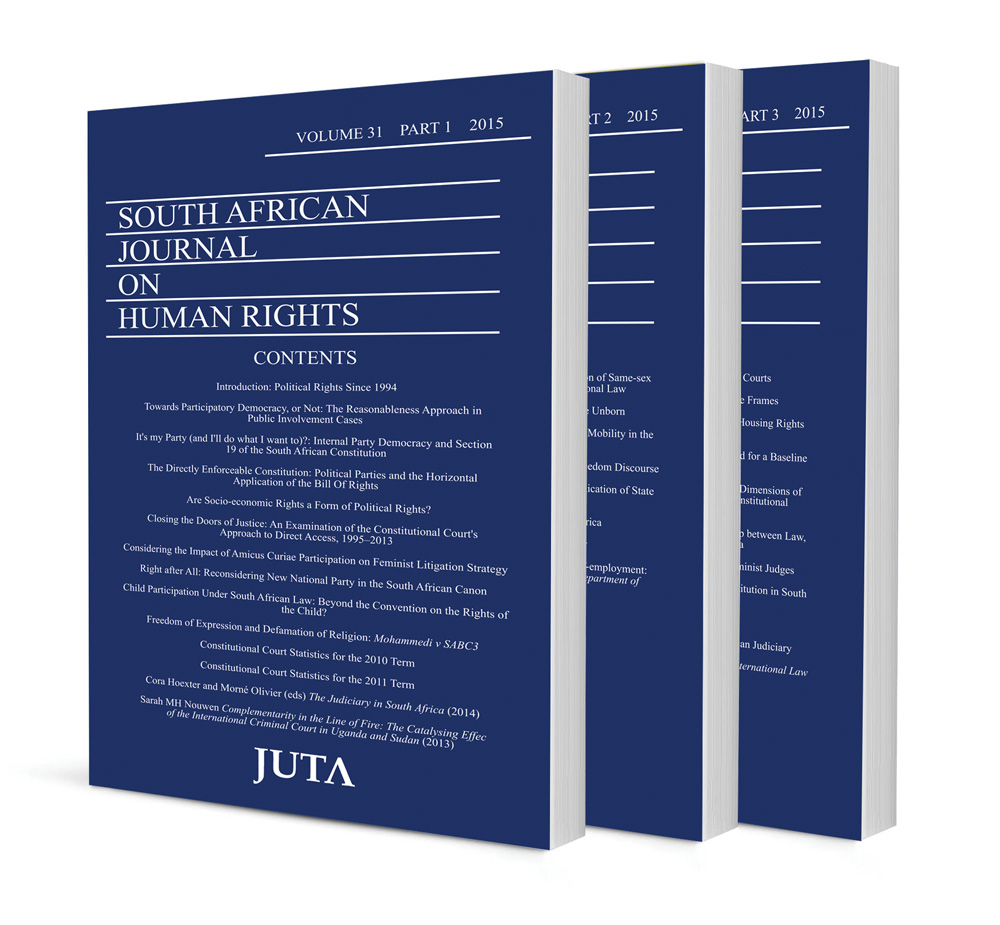
Political rights since 1994 Focus: The directly enforceable constitution: Political parties and the horizontal application of the Bill of Rights

Authors Michael Dafel

ISSN: 1996-2126
Affiliations: Researcher, South African Institute for Advanced Constitutional, Public, Human Rights, and International Law, a Centre of the University of Johannesburg (SAIFAC)
Source: South African Journal on Human Rights, Volume 31 Issue 1, 2015, p. 56 – 85

Abstract

Ramakatsa v Magashule signifies the first time the Constitutional Court permitted an individual to base a cause of action against another non-state actor, in this case a political party, solely on the contents of a right entrenched in the Bill of Rights. In doing so, the court moved away from the development of the common law in terms of s 8 or s 39 (2) of the Constitution as the means to incorporate constitutional rights or values into the law that regulates the legal relationship between non-state actors, and, in effect, recognised a third methodological pathway through which fundamental rights applies horizontally between non-state actors. Following this seminal decision, it is necessary to modify South African constitutional theory on horizontal application to reflect the three means through which the Bill of Rights applies to private relations. It is also necessary to consider whether the new methodological pathway the court recognised in terms of s 172(1) of the Constitution may apply to other non-state actors.

Political rights since 1994 Focus: It’s my party (and I’ll do what I want to)?: Internal party democracy and section 19 of the South African Constitution

Political rights since 1994 Focus: It’s my party (and I’ll do what I want to)?: Internal party democracy and section 19 of the South African Constitution

Authors Pierre de Vos

ISSN: 1996-2126
Affiliations: Claude Leon Foundation Chair in Constitutional Governance, Department of Public Law, University of Cape Town
Source: South African Journal on Human Rights, Volume 31 Issue 1, 2015, p. 30 – 55

Abstract

South Africa’s democracy has both representative and participatory elements. The participatory aspect of democracy enhances the civic dignity of citizens by empowering them to take part in decisions that affect their lives. However, the overbearing role that political parties play in the South African democracy runs the risk of limiting the ability of citizens to participate effectively in decisions that impact on their lives. This is because the leaders of political parties (especially of governing parties) may wield enormous power and influence inside their respective parties and in the legislature and executive. Where the ordinary members of parties have little or no direct say about the formulation of the policies of the party they belong to or the election of its leaders or those who will stand for election as public representatives at national and provincial level, the ability of such members to participate in democratic processes and decisions are limited. To facilitate the participation of party members in the activities of a political party to ensure the enhancement of their civic dignity s 19(1)(b) of the Constitution guarantees the right of every citizen freely to make political choices, including the right to participate in the activities of, or recruit members for, a political party. In Ramakatsa v Magashule the majority of the Constitutional Court affirmed the importance of the right of party members to participate freely in the activities of the political party they belong to and also found that the constitutions of political parties have to ensure this happens. Provisions of a political party’s constitution can be declared invalid if it fails to comply with the provisions of the Bill of Rights (including s 19(1)(b)). This article contends that Ramakatsa can be interpreted to place a positive duty on the legislature to pass a ‘party law’ that sets minimum requirements to protect the democratic participation of party members in the activities of the party — including about the formulation of party policies, the election of party office bearers and the selection of the party’s candidates for election as public representatives.

Political rights since 1994 Focus: Towards participatory democracy, or not: The reasonableness approach in public involvement cases

Political rights since 1994 Focus: Towards participatory democracy, or not: The reasonableness approach in public involvement cases

Authors Ngwako Raboshakga

ISSN: 1996-2126
Affiliations: Researcher at the South African Institute for Advanced Constitutional, Public, Human Rights and International Law (SAIFAC), a centre of the University of Johannesburg
Source: South African Journal on Human Rights, Volume 31 Issue 1, 2015, p. 4 – 29

Abstract

Sections 59(1)(a), 72(1)(a) and 118(1)(a) of the Constitution require the national and provincial legislative bodies to facilitate public involvement in their legislative and other processes. This article considers the jurisprudence developed by the Constitutional Court thus far in the five cases concerning the facilitation of public involvement in legislative decision-making processes. The court adopted a reasonableness standard of review for purposes of determining whether, in each case, the constitutional obligation to facilitate public involvement has been met. Drawing on literature and a comparison with work in the field of socio-economic rights, I argue that to be meaningful and effective, a reasonableness enquiry requires a substantive engagement with the purposes underlying the relevant provision[s] in the Constitution. In the first two public involvement cases, I contend that the court’s development of the reasonableness enquiry was promising, as it sought to engage substantively with the understanding of democracy that is envisaged in the Constitution. The court developed an approach to the use of reasonableness, as a standard of review, in a manner that achieves participatory democracy, as an element of South Africa’s deep vision of democracy envisaged in the Constitution. However, unfortunately, the last three public involvement cases tend to show the court as working with a compliance- or process-oriented reasonableness enquiry. The court here evinces a weak engagement with the purposes and values which the constitutional obligation to facilitate public involvement seeks to achieve. I argue that, for the future development of jurisprudence and our constitutional democracy, the court should revert to its earlier coherent and constitutionally principled approach.

Book Review: Human dignity: Lodestar for equality in South Africa (2012)

Book Review: Human dignity: Lodestar for equality in South Africa (2012)

Authors Des Gasper

ISSN: 1996-2126
Affiliations: Professor of Human Development, Development Ethics, Public Policy; International Institute of Social Studies (The Hague);
Erasmus University Rotterdam, Netherlands
Source: South African Journal on Human Rights, Volume 31 Issue 2, 2015, p. 425 – 433

Abstract

None

Statistic: Constitutional court statistics for the 2012 term

Statistic: Constitutional court statistics for the 2012 term

Authors Grant Tungay SJ, Charmika Samaradiwakera-Wijesundara, Marc Cooke, Cebile Ndebele, Marie Wentzel, Johan Viljoen, Isabel Magaya, Lisa Chamberlain

ISSN: 1996-2126
Affiliations: Intern, Centre for Applied Legal Studies, University of the Witwatersrand; Research and Teaching Associate, School of Law, University of the Witwatersrand; Candidate Attorney; Bertha Foundation Intern, Centre for Applied Legal Studies, University of the Witwatersrand; Senior Researcher, Human Sciences Research Council; Senior Researcher, Human Sciences Research Council; Junior Researcher, Human Sciences Research Council; Deputy Director, Centre for Applied Legal Studies, University of the Witwatersrand; Senior Lecturer, School of Law, University of the Witwatersrand
Source: South African Journal on Human Rights, Volume 31 Issue 2, 2015, p. 410 – 424

Abstract

None

Thinking the boundaries of customary law in South Africa

Thinking the boundaries of customary law in South Africa

Authors Nica Siegel

ISSN: 1996-2126
Affiliations: Yale University graduate student
Source: South African Journal on Human Rights, Volume 31 Issue 2, 2015, p. 357 – 378

Abstract

This article begins by taking up the theoretical proximity between scholar and attorney Wilmien Wicomb’s conception, drawn from a hybrid of Derridean thought and cybernetic theory, of customary law within South Africa as a ‘complex system’, and the complexity theory of founding neoliberal legal thinker Friedrich Hayek, for whom cybernetic complexity theory was a substantial intellectual influence. Wicomb’s theoretical frame raises the question of the role the market plays and ought to play in the creation and maintenance of spaces within which customary law can function as an independent, constitutionally recognised source of law within South Africa. This question is of pressing importance at a moment when neoliberalism, understood as a mode of governance, is an active and harmful paradigm in the lives of members of customary communities, as well as in the legal culture more broadly, in South Africa, as an analysis of the legal norms present in South Africa’s ‘vision for 2030’, the National Development Plan, will demonstrate. Wicomb’s work, it is argued, offers an occasion for a critical rethinking of the status of customary law, its boundaries, and the kinds of legal institutions capable of responding to it at the contemporary legal moment in South Africa.

The need for a capabilities-based standard of review for the adjudication of State resource allocation decisions

The need for a capabilities-based standard of review for the adjudication of State resource allocation decisions

Authors Shanelle van der Berg

ISSN: 1996-2126
Affiliations: Mellon Early Research Career Fellow, SERAJ, Stellenbosch University
Source: South African Journal on Human Rights, Volume 31 Issue 2, 2015, p. 330 – 356

Abstract

The realisation of socio-economic rights constitutes a critical prerequisite in the struggle to eradicate poverty and inequality in South Africa. State resource allocation lies at the heart of the realisation of socio-economic rights. Courts will often be called upon to adjudicate complex, polycentric prioritisation decisions taken by the state. An appropriate review paradigm can aid courts in performing this onerous task. Capabilities, as the substantive freedom to choose the lives we have reason to value, resonate strongly with the socio-economic rights enshrined in the Constitution of the Republic of South Africa, 1996. The capabilities approach can therefore be developed to constitute a capabilities-based standard of review for the adjudication of state resource allocation decisions. The need for such a theoretically justified standard of review becomes apparent from the Constitutional Court’s insufficient focus on the content of socio-economic rights, and from the maintenance of a rigid distinction between the positive and negative duties imposed upon the state by socio-economic rights.