
Women are not a proxy: Why the Constitution requires feminist judges

Women are not a proxy: Why the Constitution requires feminist judges
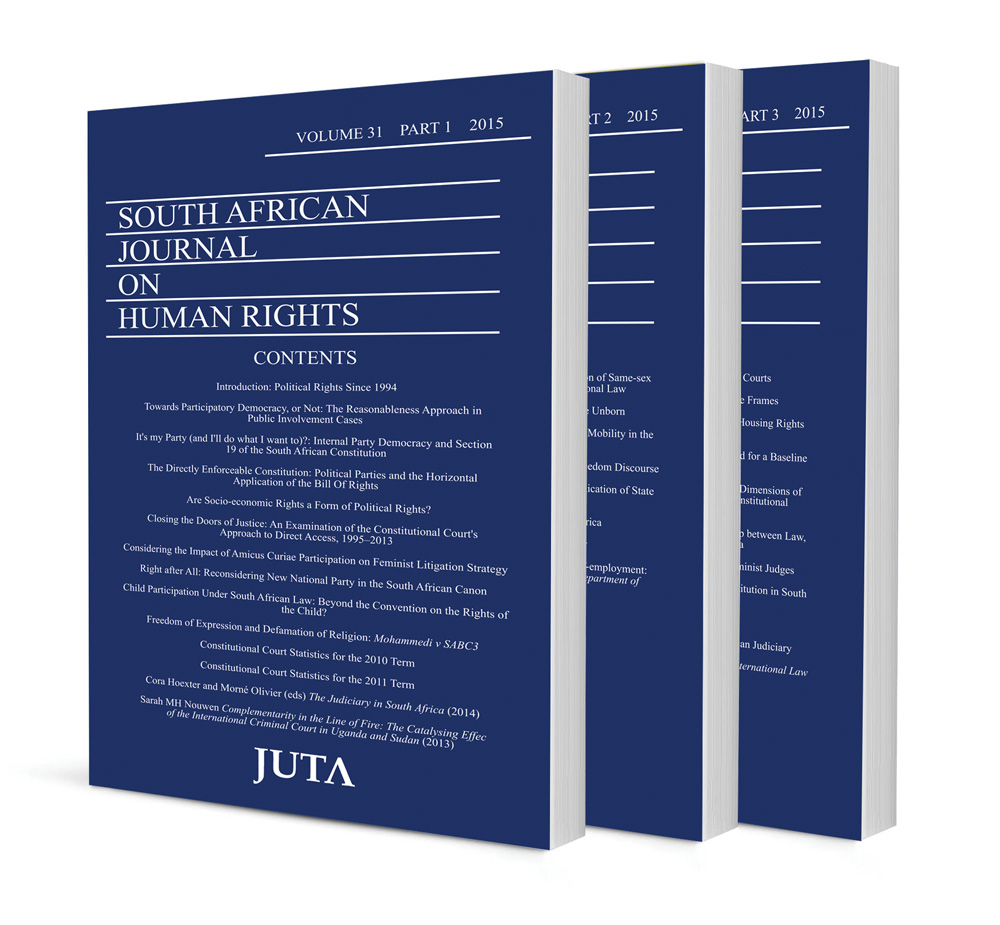
Authors Mateenah Hunter, Tim Fish Hodgson, Catharine Thorpe

ISSN: 1996-2126
Affiliations: Policy Development and Advocacy Fellow at Sonke Gender Justice; Legal Researcher at SECTION27; Researcher at the Judicial College of Victoria
Source: South African Journal on Human Rights, Volume 31 Issue 3, 2015, p. 579 – 606

Abstract

The South African Constitution entrenches the achievement of equality as a founding value and the full and equal enjoyment of all rights and freedoms as a right and prohibits discrimination based on both sex and gender. Feminism is a movement to end sexism, sexist exploitation and oppression and to end all forms of gender discrimination. The Constitution, at its core, therefore embodies a feminist ideology. This has implications for the interpretation and application of all law and policy, including s 174 of the Constitution which requires the Judicial Service Commission (JSC) to consider ‘the need for the judiciary to reflect broadly the racial and gender composition of South Africa when judicial officers are appointed’. Broadly, the JSC’s conduct between 1994 and 2014 evidences a failure to understand both gender and its constitutional mandate in terms of s 174 to proactively pursue the appointment of both female and feminist judges. Attempts to appoint more women, absent an appropriate understanding of gender, have resulted in both subtle and overt discrimination against female candidates for judicial selection. In order to remedy its misguided approach and fulfil its mandate the JSC must produce detailed guidelines on its approach to gender transformation of the judiciary, grounded in a feminist understanding of the Constitution. A unified feminist movement which embraces South Africa’s feminist Constitution, with the support of a broad coalition of human rights advocacy groups and activist organisations, is urgently needed to guide the JSC in its understanding of feminism and gender, but also to hold the JSC to account when it betrays this mandate. Women are not a proxy for feminism; the South African judiciary is in dire need of a more feminist face.

The fiction of transformation: An analysis of the relationship between law, society and the legal profession in South Africa

The fiction of transformation: An analysis of the relationship between law, society and the legal profession in South Africa

Authors Thandiwe Matthews, Charmika Samaradiwakera-Wijesundara

ISSN: 1996-2126
Affiliations: Admitted Attorney, Senior Legal Officer, South African Human Rights Commission; Admitted Attorney, Lecturer, School of Law, University of the Witwatersrand, South Africa
Source: South African Journal on Human Rights, Volume 31 Issue 3, 2015, p. 553 – 578

Abstract

Notwithstanding South Africa recently having celebrated 20 years of its democracy, it remains one of the most unequal societies in the world. The South African Constitution guarantees the right to equality, yet the country remains divided along racial lines. In spite of numerous legislative and policy attempts to achieve substantive equality, when reflecting on the current demographic statistics, it appears that the South African legal profession finds itself embedded in this division. This speaks to the tensions that have emerged as the country struggles to balance its constitutional obligations to provide redress for discrimination suffered during apartheid while simultaneously striving to meet its economic development imperatives. Through an analysis of rights-based and human capital approaches to transformation, we argue in this article that despite the tensions between meeting transformative objectives and the needs of the economy, these goals are not incongruent. Some pertinent pieces of legislation are considered in making the argument that the transformation of the legal profession requires active transformation beyond the context of law and policy. The role of the legal profession in facilitating transformation in institutional cultures that inform it, particularly with regard to legal education and language, is explored. We argue that the profession needs to be invested in ensuring that its professional constituency adequately reflects the society it represents. This is not only as a means of achieving transformation within the profession, but more importantly, of ensuring that as custodians of the Constitution, it lives the values contained therein.

Contractual autonomy unpacked: The internal and external dimensions of contractual autonomy operating in the post-apartheid constitutional context

Contractual autonomy unpacked: The internal and external dimensions of contractual autonomy operating in the post-apartheid constitutional context

Authors Deeksha Bhana

ISSN: 1996-2126
Affiliations: Associate Professor of Law, University of the Witwatersrand
Source: South African Journal on Human Rights, Volume 31 Issue 3, 2015, p. 526 – 552

Abstract

The concept of contractual autonomy comprises two essential dimensions, namely the internal (content) and the external (reach/scope of operation) dimensions. The former dimension focuses on the substantive concept of the constitutionalised, contracting self and the latter on the extent to which contract law gives, and ought to give, credence and effect to the exercise of autonomy, as defined by the internal content dimension. In relation to contractual autonomy, the question of how to conceive of contractual autonomy in the post-apartheid constitutional context must extend both to these internal and external dimensions. Upon perusal of the cases however, one finds that not much attention has been paid to the internal (content) dimension of the above question. The courts have focused on the external (reach) dimension of this question; the stated rationale being that striking a constitutional balance between the classically individualist and collectivist ideologies re-defines the contractual doctrine of legality and thus contract law as a whole. In this article, I show how the courts’ limited approach to the concept of contractual autonomy continues to entrench a fixed (neo-) classical liberal conception of contractual autonomy within our common law of contract, which, in turn, impedes transformative constitutionalism in the private sphere of contracts.

Transformative unfair discrimination jurisprudence: The need for a baseline intensity of review

Transformative unfair discrimination jurisprudence: The need for a baseline intensity of review

Authors Chris McConnachie

ISSN: 1996-2126
Affiliations: Honorary Research Associate, Rhodes University Faculty of Law; Pupil Advocate, Johannesburg Society of Advocates
Source: South African Journal on Human Rights, Volume 31 Issue 3, 2015, p. 504 – 525

Abstract

The Constitutional Court holds that the prohibition of unfair discrimination is aimed at preventing and addressing patterns of group disadvantage. However, there is a striking inconsistency between this transformative aim and the court’s decisions in a set of five controversial cases. In Hugo, Harksen, Jordan, Volks, and Union of Refugee Women, slender majorities found discrimination to be fair despite clear indications that it entrenched patterns of group disadvantage. Existing critiques of these judgments have focused on the court’s failure to conduct a fully contextualised assessment of the impact of the discrimination. In doing so, commentators have generally overlooked an equally significant flaw in these decisions. In this article, I demonstrate that the majority judgments all adopted an indefensibly weak intensity of review in assessing the state’s justifications for the discrimination, leading the court to uphold discrimination on flimsy grounds. The error was that the majority judgments did not satisfy the ‘baseline’ intensity of review, the non-negotiable threshold of review which, I argue, ought to be applied in all unfair discrimination cases. I demonstrate that this baseline has four central requirements which were flouted in these decisions: (a) the discriminator must present a justification for the discrimination; (b) the court must subject this justification to a proportionality analysis; (c) it must apply a full proportionality analysis, exploring the legitimacy, suitability, necessity, and proportionality stricto senso of the discrimination; and (d) the court must place the evidential and argumentative burden squarely on the discriminator in assessing its justifications. These baseline requirements would have left the court with little option but to find the discrimination to be unfair in these five cases. In this light, I argue that consistent application of this baseline can help to make the court better at addressing patterns of group disadvantage in future decisions.

Conflict management in an era of urbanisation: 20 years of housing rights in the South African Constitutional Court

Conflict management in an era of urbanisation: 20 years of housing rights in the South African Constitutional Court

Authors Stuart Wilson, Jackie Dugard, Michael Clark

ISSN: 1996-2126
Affiliations: Executive Director, Socio-Economic Rights Institute of South Africa (SERI); Visiting Senior Fellow, School of Law, University of the Witwatersrand; and practicing advocate, Johannesburg Bar; Associate Professor, School of Law, University of the Witwatersrand; and honorary senior researcher, SERI; Legal Researcher, Centre for Law and Society, University of Cape Town
Source: South African Journal on Human Rights, Volume 31 Issue 3, 2015, p. 472 – 503

Abstract

Over the past 20 years, of the 23 socio-economic rights decisions handed down by the South African Constitutional Court, 15 judgments have related to the s 26 right to adequate housing, making it by far the most litigated socio-economic right. The relative frequency of housing rights cases before the Constitutional Court relates to the intensity of post-apartheid struggles over access to urban and peri-urban land. Analysing the contours and consequences of the housing rights related judgments over the past 20 years, we highlight the Constitutional Court’s role as arbiter of clashing rights of ownership and occupation in the context of evolving and inadequately-managed urbanisation.